MARK CHANGIZI

Cognitive Science, Rensselaer


See WIRED.com for a story about harnessing our brain's visual system for computation.

See my SCIENTIFIC AMERICAN interview.

See The New York Times, LIVE SCIENCE and Scientific American MIND for illusion stories.

And see me on FOX News Channel.


NEW PAPER ALERTS!


Theoretical Neuroscience and Vision

Understanding the design principles shaping organisms, brains, vision, language and cultural artifacts.


Summary, News, Contact, Education, Employment, Publications, Grants, Press, Talks, Courses, Details, Sponsorship                                                                                                                                                      

    VISION
  1. VISUAL OXIMETRY: Harnessing color vision for oximetry || 1 ||
  2. BINOCULARITY: "X-ray vision" and why we have forward-facing eyes || 1 ||
  3. VISUAL COMPUTATION: Harnessing your visual system to carry out computations || 1 news: a b c d e f g h i j ... ||
  4. PREFERENCE: Mere exposure, and why seeing rationally affects what we like || 1 chapter ||
  5. EVOLUTION of COLOR: Bare skin, blood, and why we see in color || 1 chapter news: a b c d e f g h i j k ... ||
  6. LETTER SHAPE: Natural scenes drive the shapes of visual signs || 1 2 news: a b c d e f g h i j k ... ||
  7. ILLUSIONS: Perceiving-the-present: a unifying theory of illusions || 1 2 3 chapter book news: a b c d e f g h i j k ... ||
  8. THIRST & PERCEPTION: How thirst modulates the perception of transparency || 1 news: a b c ||
    COGNITIVE SCIENCE
  1. LEXICON: Organization, economy and number of hierarchical levels in the lexicon || 1 news: a b c d e f ||
  2. WRITING SYSTEMS: Complexity of writing over human history || 1 news: a b c d e f g h i j k ... ||
  3. APPETITE: Learning of thirst and hunger in rats; acquisition of appetitive behavior || 1 ||
  4. RIDDLE of INDUCTION: A general theory of prior probability || 1 book ||
  5. VAGUENESS of LANGUAGE: Why natural language is vague || 1 2 book ||
  6. AHA! MOMENTS: Mathematical inevitability of the "Eureka" phenomenon || 1 2 ||
  7. LEARNING THEORY: Ultimate computational limits on learning || 1 2 ||
    THEORETICAL (NEURO)BIOLOGY
  1. CITIES: Scaling principles for city highway networks || 1 ||
  2. VISUAL CORTEX: Why there are about 15 hierarchical levels in the ventral stream || 1 ||
  3. BRAIN SCALING: Principles governing how bigger brains are made || 1 2 chapter encycl book ||
  4. MAMMALIAN BEHAVIOR: Behaviors, muscles and encephalization || 1 book ||
  5. NEURON and ARTERY SHAPE: Self-organization and optimality of neurons and arteries || 1 2 ||
  6. NUMBER of LIMBS: Why animals have as many limbs as they do || 1 book demo news: a b ||
  7. COMPLEX NETWORKS: Evolution of complexity in organisms and languages. || 1 2 3 4 5 book news: a ||                                                                                                                        
TOP NEWS                                                                                                                                      
CONTACT INFORMATION                                                                                                                                                                                                

    POST
    Dr. Mark A. Changizi
    Cognitive Science Department
    Rensselaer Polytechnic Institute
    Troy, NY 12180
    USA

    PHONE 518-276-6472
    FAX 518-276-3017 (also 8268)

    ROOM 311 Carnegie Building

    E-MAIL changizi@rpi.edu or changizi@changizi.com or changizi@yahoo.com [They all go to Yahoo.]

    THIS WEB PAGE IS AT ... www.changizi.com

EDUCATION                                                                                                                                                                                                                        

    PhD. Applied Mathematics, University of Maryland, USA, 1997.
      Computer Science Advisors: Dr. Carl Smith, Dr. William Gasarch.
      Philosophy Advisors: Dr. Christopher Cherniak, Dr. Frederick Suppe.
      Neuroscience Advisor: Dr. Christopher Cherniak.

    B.S. Physics, Mathematics, University of Virginia, USA, 1991.

    High School Diploma. Thomas Jefferson H. S. for Science and Technology, USA, 1987. [ Notable alumnus ]

EMPLOYMENT                                                                                                                                                                                                                                                
Post-PhD
  • Assistant Professor, Cognitive Science, Rensselaer Polytechnic Institute, 2007-.
  • Sloan-Swartz Fellow, Sloan-Swartz Center for Theoretical Neurobiology, Caltech, 2002-2006.
  • Postdoctoral Fellow, Psychological and Brain Sciences, Duke University, 2000-2002.
  • Neuroscience Consultant, Schafer Biotechnology, Arlington, VA, 1998-1999.
  • Visiting Assistant Professor, Computer Science, University College Cork, Ireland, 1997-1998.
Pre-PhD
  • Neuroanatomy Research Assistant, University of Maryland, 1993-1997.
  • Lecturer, Department of Mathematics, University of Maryland, 1995-1997.
  • Laboratory Lecturer, Department of Physics, George Mason University, 1992-1995.
  • Lecturer, Department of Philosophy, University of Maryland, Summer 1994.
  • Teaching Assistant, Department of Philosophy, University of Maryland, Fall 1993.
  • Lab Assistant, Image Recognition Laboratory, University of Maryland, Fall 1992.
  • Undergrad Lab Assistant, Stanford Linear Accelerator, University of Virginia, Spring 1992.
  • Undergrad Lab Assistant, Cosmic Ray Physics, University of Utah, Summer 1991.
  • Undergrad Lab Assistant, Fermi Accelerator Laboratory, Summer 1990.
  • Undergrad Lab Assistant, Dept of Astronomy, University of Maryland, Summer 1989.

EXTERNAL FELLOW

ARTICLES AND BOOKS                                                                                                                                                                                                                                                

BOOKS
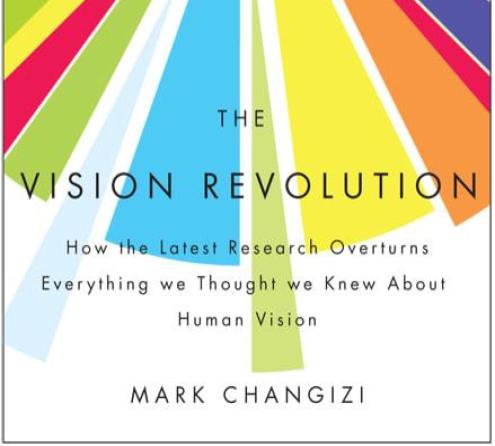
  1. Changizi MA (2009)
    THE VISION REVOLUTION: How the Latest Research Overturns Everything We Thought We Knew About Human Vision
    (BenBella Books). [ PDF Blurb ] [ News stories: The New York Times, Scientific American ]

  2. Changizi MA (2003)
    THE BRAIN FROM 25,000 FEET: High Level Explorations of Brain Complexity, Perception, Induction and Vagueness
    (Kluwer Academic, Dordrecht). Description, Buy the book at Amazon, Table of contents (pdf), [Chapter 1: Scaling in Nervous Networks], [Chapter 2: Inevitability of Illusions], [Chapter 3: Induction and Innateness], [Chapter 4: Vagueness and Consequences of a Finite Brain], A review in Synthese by Dan Ryder.

ARTICLES

Submitted
  1. Changizi MA, Brucksch M, Kotecha R, McDonald K & Rio K
    Ecological warnings.
    Under review. [ not yet available ]

  2. Changizi MA & Rio K
    Harnessing color vision for oximetry.
    Under review. [ not yet available ]

  3. Changizi MA & Destefano M.
    Common scaling laws for city highway systems and the mammalian neocortex.
    Under review. [ PDF preprint ]

Accepted
  1. Changizi MA & Shimojo S (2008)
    A functional explanation for the effects of visual exposure on preference.
    Perception, to appear. [ PDF preprint ]

  2. Changizi MA & Shimojo S (2008)
    "X-ray vision" and the evolution of forward-facing eyes.
    Journal of Theoretical Biology, to appear. [ PDF preprint ]

  3. Changizi MA (2008)
    Harnessing vision for computation.
    Perception 37: 1131-1134. [ PDF preprint ]
    [ News stories: Wired.com, Science Daily, DailyTech, ScienceAGoGo, Tendencias, NEWS.XMNN, CNews, KopalniaWiedzy, Dr. Dobb's, Technology Research News Magazine ]

  4. Changizi MA (2008)
    Economically organized hierarchies in WordNet and the Oxford English Dictionary
    Journal of Cognitive Systems Research 9: 214-228. [ PDF reprint ]
    [ News stories: Scientific American, Tendencias (Spain), RPI News, Red Orbit, New Kerala, United Press International ]

  5. Changizi MA, Hsieh A, Nijhawan R, Kanai R & Shimojo S (2008)
    Perceiving-the-present and a systematization of illusions.
    Cognitive Science 32: 459-503. [ PDF preprint ]
    [ News stories: The New York Times, Spiegel, Scientific American, FOX News Channel (live television interview), Albany's Channel 10 News (television interview), Live Science (picked up in Yahoo News, MSNBC, Fox News, and worldwide), Scientific American Mind, Sync (Dutch), Lufthansa Exclusive, RPI News, Caltech News, Newsland (Russian), Science Daily, Times of India, MSN India, Technocrat, Tarakosh Josh!, Lawrence Journal-World, TechRevu, DVICE, Technovelgy ]

  6. Changizi MA (2006)
    The optimal human ventral stream from estimates of the complexity of visual objects.
    Biological Cybernetics 94: 415-426. [ PDF reprint ]

  7. Changizi MA, Zhang Q & Shimojo S (2006)
    Bare skin, blood, and the evolution of primate color vision.
    Biology Letters 2: 217-221. [ PDF reprint ]
    [ News stories: Reuters, New Scientist, Financial Times, Scientific American, Discover Magazine, Bild der Wissenschaft (roughly a German Scientific American), ABC News, American Scientist, Science Magazine (controversy), Time Magazine, Daily Telegraph, Daily Telegraph (Santa), Pasadena Star News, The Times of London, BBC Wildlife Magazine, Bluesci (Cambridge Science Magazine), Rhein Zeitung, Ingenioren, Der Standard, Die Presse, Ego-Net, GEO Magazine, 3SAT, Die Welt, Kagaku (Japanese scientific magazine), Nikkei Science, Iran Daily, Arkadas, Asahi Shimbun, CBC News, The Independent (London), Best Friends Magazine, Ceske Novinky, CNet, 24 ThoiSu, 123, Caltech news, Impact, Fugle og Natur, Anthropology.net, Complexity Digest, The Telegraph (Calcutta, India), Softpedia News, Erkenntnisse des Neuromarketing, CBC "As It Happens" (RealAudio) Loh Down on Science Radio Show script and the RealAudio clip ]

  8. Changizi MA, Zhang Q, Ye H & Shimojo S (2006)
    The structures of letters and symbols throughout human history are selected to match those found in objects in natural scenes.
    The American Naturalist 167: E117-E139. [ PDF reprint, May 2006 Featured Article ]
    [ News stories (and related): Daily Telegraph, USA Today, Newsweek (print and online), NRC Handelsblad, Australian Broadcasting Company, Mokslo Lietuva, Live Science, Columbia Tribune, Softpedia News, Suddeutsche Zeitung, De Morgen, Svoboda News, USA Today Tech Space, Netinfo.bg Bulgaria, Internet Haber, Nikolaev, Engineering and Science Magazine, Caltech News EurekAlert, CURJ ]

  9. Changizi MA & He D (2005)
    Four correlates of complex behavioral networks: differentiation, behavior, connectivity and compartmentalization.
    Complexity 10: 13-40. [ PDF reprint ]
    [ News stories: Complexity Digest ]

  10. Changizi MA & Shimojo S (2005)
    Parcellation and area-area connectivity as a function of neocortex size.
    Brain, Behavior and Evolution 66: 88-98. [ PDF reprint ]

  11. Changizi MA & Shimojo S (2005)
    Character complexity and redundancy in writing systems over human history.
    Proc Roy Soc Lond B 272: 267-275. [ PDF reprint ]
    [ News stories: New Scientist, Natural History Magazine, Spiegel, Jay Ingram (of Discovery Channel), Bild der Wissenschaft (roughly a German "Scientific American"), Wissenschaft-online, ORF, Arzte Zeitung, San Diego Union-Tribune, GEO, Net Hirlap, Asahi Shimbun ]

  12. Changizi MA (2003)
    The relationship between number of muscles, behavioral repertoire size, and encephalization in mammals.
    Journal of Theoretical Biology 220: 157-168. [ PDF reprint] [see also book Chapter 1, Section 2 ]

  13. McShea D & Changizi MA (2003)
    Three puzzles in hierarchical evolution.
    Integrative and Comparative Biology 43: 74-81. [ Winzipped PDF reprint ]

  14. Changizi MA, McDannald MA & Widders D (2002)
    Scaling of differentiation in networks: Nervous systems, organisms, ant colonies, ecosystems, businesses, universities, cities, electronic circuits, and Legos.
    Journal of Theoretical Biology 218: 215-237. [ PDF reprint ] [ see also book Chapter 1, Section 2 ]

  15. Changizi MA & Widders D (2002)
    Latency correction explains the classical geometrical illusions.
    Perception 31: 1241-1262. [ Winzipped PDF reprint ] [ see also book Chapter 2 ]
    [ News stories: Gehirn & Geist ]

  16. Changizi MA, McGehee RMF & Hall WG (2002)
    Evidence that appetitive responses for dehydration and food-deprivation are learned.
    Physiology and Behavior 75: 295-304. [ PDF reprint ]

  17. Changizi MA & Hall WG (2001)
    Thirst modulates a perception.
    Perception 30: 1489-1497. [ Winzipped PDF reprint ]
    [ News stories: Trends in Cognitive Sciences, The Psychologist, Science Magazine ]

  18. Changizi MA (2001)
    'Perceiving the present' as a framework for ecological explanations of the misperception of projected angle and angular size.
    Perception 30: 195-208. [ PDF reprint ] [ see also book Chapter 2 ]
    [ News stories: Gehirn & Geist ]

  19. Changizi MA (2001)
    Principles underlying mammalian neocortical scaling.
    Biological Cybernetics 84: 207-215. [ PDF reprint ] [ see also book Chapter 1, Section 1 ]

  20. Changizi MA (2001)
    Universal laws for hierarchical systems.
    Comments on Theoretical Biology 6: 25-75. [ PDF reprint ] [ see also book Chapter 1, Section 2 ]

  21. Changizi MA (2001)
    Universal scaling laws for hierarchical complexity in languages, organisms, behaviors and other combinatorial systems.
    Journal of Theoretical Biology 211: 277-295. [ PDF reprint ] [ see also book Chapter 1, Section 2 ]

  22. Changizi MA (2001)
    The economy of the shape of limbed animals.
    Biological Cybernetics 84: 23-29. [ Winzipped PDF reprint ] [ DEMO ] [ see also book Chapter 1, Section 3 ]
    [ News stories (and related): Tubitak Bilim ve Teknik , Science.ca ]

  23. Changizi MA & Cherniak C (2000)
    Modeling the large-scale geometry of human coronary arteries.
    Canadian J. of Physiol. and Pharmacol. 78: 603-611. [ PDF reprint ]

  24. Cherniak C, Changizi MA & Kang D (1999)
    Large-scale optimization of neuron arbors.
    Physical Review E 59: 6001-6009. [ PDF reprint ]

  25. Changizi MA (1999)
    Vagueness, rationality and undecidability: A theory of why there is vagueness.
    Synthese 120: 345-374. [ PDF reprint ] [ see also book Chapter 4 ]

  26. Changizi MA (1999)
    Vagueness and computation.
    Acta Analytica 14: 39-45.

  27. Changizi MA & Barber T (1998)
    A paradigm-based solution to the riddle of induction.
    Synthese 117: 419-484. [ PDF reprint ] [ see also book Chapter 3 ]

  28. Changizi MA (1997)
    Learning with natural imprecision.
    Int. J. of Foundations of Computer Science 8: 409-424. [ PDF reprint ]

  29. Changizi MA (1996)
    Function identification from noisy data with recursive error bounds.
    Erkenntnis 45: 91-102.

  30. Changizi MA (1996)
    Self-monitoring machines and an w^w-hierarchy of loops.
    Information and Computation 128: 127-138. [ PDF reprint ]

CONTRIBUTED CHAPTERS
  1. Changizi MA & Shimojo S (2008)
    Social color vision.
    In R. B. Adams, Jr., N. Ambady, K. Nakayama & S. Shimojo (Eds.)
    The Science of Social Vision. New York, Oxford U. Press.

  2. Shimojo S & Changizi MA (2008)
    Influence of gaze behavior on preference.
    In R. B. Adams, Jr., N. Ambady, K. Nakayama & S. Shimojo (Eds.)
    The Science of Social Vision. New York, Oxford U. Press.

  3. Changizi MA, Hsieh A, Nijhawan R, Kanai R & Shimojo S (2007)
    Perceiving-the-present and a unified theory of illusions.
    In R. Nijhawan & B. Khurana (Eds.),
    Problems of Space and Time in Perception and Action. Cambridge, Cambridge U. Press.

  4. Changizi MA (2007)
    Brain scaling laws.
    In Squire LR (ed.) New Encyclopedia of Neuroscience. Oxford, Elsevier. [ PDF preprint ]

  5. Changizi MA (2007)
    Scaling the brain and its connections.
    In Kaas JH (ed.) Evolution of Nervous Systems. Oxford, Elsevier. [ PDF preprint ]

BOOK REVIEWS and COMMENTARIES
  1. Changizi MA (2008)
    The trade-off between speed and complexity.
    Invited commentary on Nijhawan R, Visual Prediction: Psychophysics and neurophysiology of compensation for time delays.
    Behavioral and Brain Sciences. [ PDF reprint ]

  2. Changizi MA (2003)
    The politically correct monkey.
    A review of Ian Tattersall (2002) The Monkey in the Mirror, Oxford University Press, Oxford.
    Heredity 90: 278. [ PDF reprint ]

  3. Changizi MA (2003)
    Mathematica's first academic monograph.
    A review of Stephen Wolfram (2002) A New Kind of Science, Wolfram Media, Champaigne, IL.
    Complexity 8(2): 63-65. [ PDF reprint ]

  4. Changizi MA (2002)
    The intricate process of implication.
    A review of Mark C. Taylor (2001) The Moment of Complexity, The University of Chicago Press.
    Complexity 7(3): 17-18. [ PDF reprint ]

GRANTS                                                                                                                                                                                                                                                                                                                      
  1. 2008. The Class of 1951 Outstanding Teaching Development Grant .
    Topic: Visual circuits: A novel notation system for undergraduate education of digital circuits and propositional logic.
    Amount: Partial summer salary, student funds and miscellaneous expenses.

  2. 2004-2007. NIH Ruth L. Kirschstein National Research Service Award (NRSA) Postdoctoral Fellowship.
    Topic: Perceiving-the-present: A general theory of illusions.
    Amount: Three year grant, funding full salary and miscellaneous expenses. [1 F32 EY015370-01]

  3. 2002-2004. Sloan-Swartz Fellowship.
    Topic: Theoretical neurobiology.
    Amount: Two year grant, funding partial salary and miscellaneous expenses.
PRESS                                                                                                                                                                                                                                                
  1. My research generally: Scientific American (an interview).

    THE VISION REVOLUTION (pre-release): The New York Times, Scientific American (an interview).

    Turning your visual system into a programmable computer: Wired.com, Science Daily, DailyTech, ScienceAGoGo, Tendencias, NEWS.XMNN, CNews, KopalniaWiedzy, Dr. Dobb's, Technology Research News Magazine

    Perceiving-the-present theory of illusions: The New York Times, Spiegel, Scientific American, FOX News Channel (live television interview), Albany's Channel 10 News (television interview), Live Science (picked up in Yahoo News, MSNBC, Fox News, and worldwide), Scientific American Mind, Sync (Dutch), Lufthansa Exclusive, RPI News, Caltech News, Newsland (Russian), Science Daily, Times of India, MSN India, Technocrat, Tarakosh Josh!, Lawrence Journal-World, TechRevu, DVICE, Technovelgy

    Dictionaries for the brain: Scientific American, Tendencias (Spain), RPI News, Red Orbit, New Kerala, United Press International

  2. Thirst modulates perception: Science Magazine

    Letters and other visual signs look like nature: Columbia Tribune

    Color evolved for seeing blushing, blanching, etc.: GEO Magazine, Science Magazine, Daily Telegraph (Santa), Nikkei Science

  3. Evolution of writing systems: Asahi Shimbun

    Number-of-limbs discovery: Tubitak Bilim ve Teknik

    Letters and other visual signs look like nature : Daily Telegraph, USA Today, Newsweek (print and online), NRC Handelsblad, Australian Broadcasting Company, Mokslo Lietuva, Live Science, Softpedia News, Suddeutsche Zeitung, De Morgen, Svoboda News, USA Today Tech Space, Netinfo.bg Bulgaria, Internet Haber, Nikolaev, Engineering and Science Magazine, Caltech News, EurekAlert, CURJ

    Color evolved for seeing blushing, blanching, etc. : Reuters, New Scientist, Financial Times, Scientific American, Discover Magazine, Bild der Wissenschaft (roughly a German Scientific American), ABC News, American Scientist, Time Magazine, Daily Telegraph, Pasadena Star News, The Times of London, BBC Wildlife Magazine, Bluesci (Cambridge Science Magazine), Rhein Zeitung, Ingenioren, Der Standard, Die Presse, Ego-Net, 3SAT, Die Welt, Kagaku (Japanese scientific magazine), Iran Daily, Arkadas, Asahi Shimbun, CBC News, The Independent (London), Best Friends Magazine, Ceske Novinky, CNet, 24 ThoiSu, 123, Caltech news, Impact, Fugle og Natur, Anthropology.net, Complexity Digest, The Telegraph (Calcutta, India), Softpedia News, Erkenntnisse des Neuromarketing, CBC "As It Happens" (RealAudio), Loh Down on Science Radio Show script

  4. Unified framework for scaling in complex behavioral networks: Complexity Digest

    Perceiving-the-present theory of illusions: Gehirn & Geist

    Evolution of writing systems: New Scientist, Natural History Magazine, Spiegel, Jay Ingram (from Discovery Channel), Wissenschaft, Wissenschaft-Online, ORF, Arzte Zeitung, San Diego Union-Tribune, GEO, Net Hirlap

  5. My first book, The Brain from 25000 Feet: A review in Synthese by Dan Ryder

    Number-of-limbs discovery : Science.ca (popular Canadian science web site)

  6. Thirst modulates perception: Trends in Cognitive Sciences, The Psychologist
TALKS                                                                                                                                                                                                                                                
  1. Harnessing the visual brain.
        Meeting of the Defense Threat Reduction Agency, Atlanta, GA, 8/08.
  2. The structures of letters and symbols throughout human history are selected to match those found in objects in natural scenes,
        Vision Science Society, invited speaker, Naples, FL, 5/08.
  3. What's binocular vision for, anyway?,
        Center for Neuroscience and Neuropharmacology, Albany Medical Center, 3/08.
  4. What's binocular vision for, anyway?,
        Cognitive Science Colloquium, University of Connecticut, 11/07.
  5. What's binocular vision for, anyway?,
        Advanced Imaging Center, Albany Medical Center, 11/07.
  6. Big mammalian brain recipes,
        Department of Cognitive Science, Rensselaer Polytechnic Institute, 9/07.
  7. Seeing the forest through the trees: X-ray vision and the evolution of forward facing eyes,
        Department of Cognitive Science, Rensselaer Polytechnic Institute, 2/07.
  8. Seeing the forest through the trees: X-ray vision and the evolution of forward facing eyes,
        Department of Psychology, UCLA, 12/06.
  9. Big mammalian brain recipes,
        Laboratory of Neuro Imaging, UCLA, 11/06.
  10. Letters from nature,
        Center for Behavior, Evolution and Culture, Department of Anthropology, UCLA, 10/06.
  11. Big mammalian brain recipes,
        Neurology Grand Rounds, UCLA, 10/06.
  12. Visual linguistics,
        Microsoft Typography Group, Redmond, WA, 6/06.
  13. Big brains,
        Psychology Department, University of Nevada, Reno, 2/06.
  14. Visual linguistics, and Why letters are shaped the way they are,
        Psychology Department, Franklin and Marshall College, 2/06.
  15. Why we see illusions, and why we see in color,
        Psychology Department, Franklin and Marshall College, 2/06.
  16. Visual linguistics, and Why letters are shaped the way they are,
        Cognitive Science Department, Rensselaer Polytechnic Institute, 2/06.
  17. Visual linguistics, and Why letters are shaped the way they are,
        Department of Cognitive and Linguistic Sciences, Brown University, 2/06.
  18. Visual linguistics, and Why letters are shaped the way they are,
        Seaver Foundation Program in Bioinformatics, Albert Einstein College of Medicine, 2/06.
  19. Visual linguistics, and Why letters are shaped the way they are,
        Department of Anthropology, George Washington University, 1/06.
  20. Color, blood, skin and emotion: A general functional theory of color vision,
        Shimojo Implicit Brain Project, Exploratory Research for Advanced Technology Seminar, Japan Science and Technology Agency, 6/05.
  21. Big brains, and analogies with other complex networks,
        School of Life Sciences, Arizona State University, 3/05.
  22. Why letters are shaped the way they are,
        Department of Cognitive Science, UC Irvine, 1/05.
  23. Natural scene statistics and the structure of visual signs over human history,
        Kavli Institute for Theoretical Physics, Brain Theory Program, UC Santa Barbara 9/04.
  24. The structures of letters throughout human history are selected to match those found in objects in natural scenes,
        Sloan-Swartz Theoretical Neurobiology Meeting, Cold Spring Harbor Laboratory, 7/04.
  25. Complexity and redundancy of writing systems over human history,
        Perona Laboratory, Caltech, 5/04.
  26. Principles of connectivity and parcellation in neocortex and other networks,
        Center for the Study of Biological Complexity, Virginia Commonwealth University, 5/04.
  27. Principles of connectivity and parcellation in neocortex and other networks,
        Buszaki Laboratory, Rutgers, 5/04.
  28. How to (and not to) recognize the intelligent brains without seeing the behaviors,
        Astrobiology Science Conference [invited by SETI to speak at the session on Evolution of Intelligence], NASA Ames Research Center, 3/04.
  29. Complexity and redundancy of writing systems over human history,
        Complexity Club, Caltech, 3/04.
  30. Principles of connectivity and parcellation in the neocortex and other networks,
        School of Informatics, Indiana University, 2/04.
  31. Perceiving-the-present, a unifying framework for visual perception,
        Sloan-Swartz Center for Theoretical Neurobiology, Caltech, 1/04.
  32. Principles of connectivity and parcellation in neocortex.
        Sloan-Swartz Theoretical Neurobiology Meeting, Salk Institute, 7/03.
  33. Perceiving the present explains more than 50 illusion classes,
        Computational Neurobiology Lab, Salk Institute, 7/03.
  34. A general framework for complex networks,
        Complexity Club, Caltech, 7/03.
  35. Perceiving the present, and a general ecological theory of illusions of projected size, projected speed, luminance contrast, and distance,
        Koch Laboratory, Caltech, 3/03.
  36. The principles shaping the neocortex, and comparison to other networks,
        Sloan-Swartz Center for Theoretical Neurobiology, Caltech, 3/03.
  37. The scarcity of universal languages in nature, and How to carve networks at their joints,
        Complexity Club, Caltech, 2/03.
  38. Latency correction explains the classical geometrical illusions,
        Perona Laboratory, Caltech, 11/02.
  39. Scaling of differentiation in networks, and an explanation for species-area plots,
        Department of Ecology and Evolutionary Biology, Princeton University, 7/02.
  40. Scaling of differentiation in networks,
        Lewis-Sigler Institute, Princeton University, 4/02.
  41. Why we see the classical illusions,
        Departments of Mathematics and Biology, University of Massachusetts at Boston, 2/02.
  42. Why we see the classical illusions,
        Bryn Mawr College, 1/02.
  43. Latency correction explains the classical geometrical illusions,
        Cold Spring Harbor Laboratory, 3/01.
  44. Universal scaling laws in languages, organisms, behaviors and other combinatorial systems,
        Department of History and Philosophy and Science, Indiana University, 3/01.
  45. Latency correction explains the classical geometrical illusions,
        Cognitive Science Program, Indiana University, 3/01
  46. Universal scaling laws in combinatorial sytems,
        Department of Computer Science, University of Central Florida, 1/01.
  47. Evolution of component-type, function and behavioral complexity,
        Department of Psychology, Duke University, 10/00.
  48. Perceiving the present,
        Department of Psychology, Duke University, 9/00.
  49. The network diameter of the neocortex,
        Department of Biomedical Engineering, University of North Carolina, Chapel Hill, 5/00.
  50. VLSI animals: How animals save wire from head to toe,
        Department of Zoology, Duke University, 1/00.
  51. Principles underlying mammalian neocortical scaling,
        Department of Neurobiology, Duke University, 9/99.
  52. Towards a new logic and semantics for natural language,
        International Conference on Formal Methods, National University of Ireland, Cork, Ireland, 7/98.
  53. Vagueness and computation,
        Conference on Vagueness, Bled, Slovenia, 6/98.
  54. The Eureka phenomenon as a consequence of being finite,
        Department of Computer Science, National University of Ireland, Cork, Ireland, 2/98.
  55. Vagueness and undecidability,
        Department of Computer Science, National University of Ireland, Cork, Ireland, 2/97.
  56. Prior probabilities and the rule of succession,
        Recursion Theory Seminar, University of Maryland, 9/96.
  57. The paradigm of impossibility,
        Graduate Philosophy Colloquium, University of Maryland, 2/96.
  58. Fuzziness in classical two-valued logic,
        The Joint Conference of ISUMA/NAFIPS, University of Maryland, 9/95.
  59. Undecidability of analyticity in natural language,
        Graduate Philosophy Colloquium, University of Maryland, 3/95.
  60. Vagueness and undecidability,
        Cognitive Science Colloquium, University of Virginia, 2/94.
  61. Proving Occam's razor,
        Inductive Inference Seminar, University of Maryland, 4/93.
  62. The ultimate epistemic constraints on prediction,
        Society of Physics Students, University of Virginia, 3/91.
COURSES TAUGHT                                                                                                                                                  
  1. Cognitive Science of Art,
    Department of Cognitive Science, Rensselaer Polytechnic Institute, Spring 2008.
  2. Behavioral Neuroscience,
    Department of Cognitive Science, Rensselaer Polytechnic Institute, Spring 2008.
  3. Cognitive Science Pro-Seminar,
    Department of Cognitive Science, Rensselaer Polytechnic Institute, Fall 2007.
  4. Behavioral Neuroscience,
    Department of Cognitive Science, Rensselaer Polytechnic Institute, Fall 2007.
  5. Theoretical Neuroscience,
    Department of Cognitive Science, Rensselaer Polytechnic Institute, Spring 2007.
  6. Methods in Behavioral Neuroscience,
    Department of Experimental Psychology, Duke University, 2000-2002.
  7. Introduction to Computer Science I and II,
    Department of Computer Science, University College Cork, Ireland, 1997-1998.
  8. Teaching Assistant for Calculus I and II,
    Department of Mathematics, University of Maryland, 1996-1997.
  9. Geometry and Statistics I and II for Education Majors,
    Department of Mathematics, University of Maryland, 1995-1997.
  10. Laboratory for Introductory Physics I and II,
    Department of Physics, George Mason University, 1992-1995.
  11. Laboratory for Introductory Astronomy I and II,
    Department of Physics, George Mason University, 1992-1995.
  12. Logic,
    Department of Philosophy, University of Maryland, Summer 1994.
  13. Teaching Assistant for Philosophy and Computation,
    Department of Philosophy, University of Maryland, Fall 1993.
RESEARCH DETAILS                                                                                                                                                                                                                                                


Harnessing your visual system to carry out computations
Might it be possible to harness the visual system to carry out artificial computations, somewhat akin to how DNA has been harnessed to carry out computation? I provide the beginnings of a research programme attempting to do this. In particular, new techniques are described for building "visual circuits" (or "visual software") using wire, NOT, OR and AND gates in a visual modality such that our visual system acts as "visual hardware" computing the circuit, and generating a resultant perception which is the output. Some press occurred at the following:
Wired.com, Science Daily, DailyTech, ScienceAGoGo, Tendencias, NEWS.XMNN, CNews, KopalniaWiedzy, Dr. Dobb's, Technology Research News Magazine
    - [ PDF preprint ] Changizi MA (2008) How to harness vision for computation.
    Perception 37: 1131-1134.


Principles governing the organization of city road networks...and the brain
Cities and the mammalian neocortex may seem to have little in common, but each is approximately a surface with a network of conduits (roads and neurons, respectively) connecting its disparate parts. Because both cities and brains are under selection pressures to make their connections efficiently, we investigate the hypothesis that the organization of city highway networks and the mammalian neocortex may be governed by common principles. Here we measure how city highway networks vary with city size and find that, consistent with the hypothesis, highway networks scale with exponents nearly identical to those found for the analogous quantities in the neocortex. As a function of surface area, the number of conduits scales approximately as the 3/4 power, the number of "leaves" (highway exits and synapses) scales approximately as the 9/8 power, propagation velocity scales approximately as the 1/8 power, and total conduit surface area scales approximately as the 11/8 power. We also find that city population scales as the 1.46 power of surface area, potentially driven by the total surface area of highways. We discuss the extent to which explanations for neocortical scaling can be extended to cities.
    - [ PDF preprint ] Changizi MA & Destefano M. Common scaling laws
    for city highway systems and the mammalian neocortex. Under review.


Techniques for early visual detection of oxygen desaturation
New techniques are described that better enable human observers to perceive clinically relevant skin color changes, harnessing the natural oximetry powers of our eyes. More coming.
    - [ not available ] Changizi MA & Rio K. Harnessing color vision for oximetry. Under review.


A new function for binocular vision, and the evolution of forward-facing eyes
Why do our eyes face forward, and why do many animals have eyes facing sideways? Here we describe new research suggesting that the degree of binocular convergence is selected to maximize how much the animal can see in its environment. Animals in non-cluttery environments can see the most around them with panoramic, laterally directed eyes. Animals in cluttery environments, however, can see best when their eyes face forward, for binocularity has the power of "seeing through" clutter out in the world. Evidence across mammals closely fits the predictions of this "x-ray" hypothesis, and is hard to reconcile with traditional explanations where stereo vision is critical.
    - [ PDF preprint ] Changizi MA & Shimojo S. "X-ray vision" and the
    evolution of forward-facing eyes. Journal of Theoretical Biology, to appear.


The underlying economic rationality of preference and affect dynamics
Visual exposure to an object can modulate an observer's degree of preference for it, initially enhancing preference (a "familiarity preference" regime), and eventually lowering it again (a "novelty preference" regime). Here we investigate whether there may be a functional advantage to modulating preference in this way. We put forth the simple hypothesis that degree of preference for an object of type X is the brain's estimate of the expected value of acting to obtain X. In light of this view of what preferences fundamentally represent, we are able to explain the "exposure effect" and many of the connected phenomena.
    - [ not available ] Shimojo S & Changizi MA (2008) Influence of gaze behavior
    on preference. In R. B. Adams, Jr., N. Ambady, K. Nakayama & S. Shimojo (Eds.)
    The Science of Social Vision. New York, Oxford U. Press.
    - [
    PDF preprint ] Changizi MA & Shimojo S. A functional explanation for
    the effects of visual exposure on preference. Perception, to appear.


Bare skin, blood, emotion, and the evolution of primate color vision
The primate face undergoes color modulations (such as blushing or blanching), some which may be selected for signaling and some which may be an inevitable consequence of underlying physiological modulations. Because for highly social animals like most primates, one of the most important kinds of object to be competent at perceiving and discriminating is other members of one's own species, we hypothesized that primate color vision has been selected for discriminating the short term spectral modulations on the skin of conspecifics, these modulations providing useful information about the current state or mood of another conspecific. Here we show that for the two dimensions of skin spectral variation in the short term, the dimension due to the fraction of blood in the skin corresponds approximately to the blue-yellow opponent channel (more blood ==> bluer), and the other dimension due to oxygen saturation of the blood corresponds approximately to the red-green opponent channel (greater oxygenation ==> redder). Trichromats, but not dichromats, are therefore sensitive to both dimensions of skin color variation, and, more specifically, the wavelength sensitivities of the M and L cones for trichromatic primates are near-optimal for sensing modulations of oxygen saturation. Also, because skin color modulation cannot be seen on a furry face, trichromatic primates tend to have bare faces. See
Reuters, New Scientist, Financial Times, Scientific American, Time Magazine, Discover Magazine, Bild der Wissenschaft (roughly a German Scientific American), Daily Telegraph, Daily Telegraph (Santa), American Scientist, ABC News, Pasadena Star News, BBC Wildlife Magazine, Bluesci (Cambridge Science Magazine), Ingenioren, Der Standard, The Times of London, Rhein Zeitung, Kagaku (Japanese science magazine), Nikkei Science, CBC News, The Independent (London), Best Friends Magazine, Die Presse, Ego-Net, GEO Magazine, 3SAT, Die Welt, Iran Daily, 123, Arkadas, Ceske Novinky, Asahi Shimbun, CNet, 24 ThoiSu, Impact, Fugle og Natur, Anthropology.net, Complexity Digest, Softpedia News, Erkenntnisse des Neuromarketing, The Telegraph (Calcutta, India), and Caltech News for news stories about this (some which were picked up and translated worldwide, e.g., the New Scientist, Reuters, Pasadena Star, and Caltech News stories). Also see CBC "As It Happens" for a radio interview (go 22 minutes into RealAudio clip), and here is the script of a public radio show called Loh Down on Science that covered this research (and here is the RealAudio clip). See also Science Magazine for some controversy.
    - [ not available ] Changizi MA & Shimojo S (2008) Social color vision.
    In R. B. Adams, Jr., N. Ambady, K. Nakayama & S. Shimojo (Eds.)
    The Science of Social Vision. New York, Oxford U. Press.
    - [ PDF reprint ] Changizi MA, Zhang Q & Shimojo S (2006) Bare skin,
    blood, and the evolution of primate color vision. Biology Letters 2: 217-221.


A general theory of mammalian visual cortex organization
The part of the primate visual cortex responsible for the recognition of objects is parcelled into about a dozen areas organized somewhat hierarchically (the region is called the ventral stream). Why are there approximately this many hierarchical levels for object recognition? Here I put forth a generic information-processing hierarchical model for visual object recognition, and show how the total number of neurons required depends on the number of hierarchical levels and the complexity of visual objects that must be recognized. Because the recognition of written words appears to occur in a similar part of inferotemporal cortex as other visual objects, the complexity of written words may be similar to that of other visual objects; for this reason, I measure the complexity of written words, and use it as an approximate estimate of the complexity of visual objects more generally. I then show that the information-processing hierarchy that accommodates visual objects of that complexity possesses the minimum number of neurons when the number of hierarchical levels is approximately 15 and when the sizes of areas decrease exponentially with level, each level on average approximately 1.25 times larger than the level above it. I show that these optimal properties are close to those found in the primate ventral stream.
    - [ PDF reprint ] Changizi MA (2006) The optimal human ventral stream
    from estimates of the complexity of visual objects. Biological Cybernetics 94: 415-426.


The economical organization of the lexicon
Good definitions consist of words that are more basic than the defined word. There are, however, many ways of satisfying this desideratum. For example, at one extreme, there could be a small set of atomic words that are used to define all other words; i.e., there would be just two hierarchical levels. Alternatively, there could be very many hierarchical levels, where a small set of atomic words is used to define a larger set of words, and these are, in turn, used to define the next hierarchically higher set of words, and so on to the top level of very specific, complex words. Importantly, some possible organizations are more economical than others in the amount of space required to record all the definitions. Here I ask, How economical are dictionaries? Here I present a simple model for an optimal set of definitions, predicting on the order of 7 hierarchical levels. I test the model via measurements from WordNet and the Oxford English Dictionary, and find that the organization of each possesses the signature features expected for an economical dictionary. See a longer blurb of this
here. Some stories in the press (many which were picked up all over the world): Scientific American, Tendencias (Spain), RPI News, Red Orbit, New Kerala, United Press International.
    - [ PDF reprint ] Changizi MA (2008) Economically organized hierarchies in WordNet
    and the Oxford English Dictionary. Journal of Cognitive Systems Research 9: 214-228.


Why letters are shaped the way they are
Are there empirical regularities in the shapes of letters and other human visual signs, and if so, what are the selection pressures underlying these regularities? To examine this, we determined a wide variety of topologically distinct contour configurations, and examined the relative frequency of these configuration types across non-logographic writing systems, Chinese writing, and non-linguistic symbols. Our first, and main, result is that these three classes of human visual sign possess a similar signature in their configuration distribution, suggesting that there are underlying principles governing the shapes of human visual signs. Second, we provide evidence that the shapes of visual signs are selected to be easily seen, at the expense of the motor system. Finally, we provide evidence to support an ecological hypothesis that visual signs have been culturally selected to match the kinds of conglomerations of contours found in natural scenes, because that is what we have evolved to be good at visually processing. There are press stores about it at the
Daily Telegraph, USA Today, Newsweek (print and online), NRC Handelsblad, Australian Broadcasting Company, Mokslo Lietuva, Live Science, Suddeutsche Zeitung, Columbia Tribune, De Morgen, Softpedia News, Svoboda News, USA Today Tech Space, Netinfo.bg Bulgaria, Internet Haber, Nikolaev, Engineering and Science Magazine, Caltech News and EurekAlert. Some of these news stories were picked up worldwide, such as Live Science (e.g., picked up by Fox News and MSNBC), Caltech News and EurekAlert. See CURJ for an article by undergraduate Qiong Zhang in the Caltech undergraduate research magazine.
    - [ PDF reprint ] Changizi MA, Zhang Q, Ye H & Shimojo S (2006) The structures of letters
    and symbols throughout human history are selected to match those found in objects
    in natural scenes. The American Naturalist 167: E117-E139. [Featured Article, May 2006]


How bigger brains are made
This research answers why the neocortex is folded, why the number of synapses per neuron increases, why white matter scales up disproportionately quickly, why the number of cortical areas increases, why soma and axon radius increase, and more. The theory explaining these features posits that the neocortex is well-connected in a wire-optimal fashion. The paper also estimates the network diameter of the neocortex to be about 2. Newer research appears in Section 1.1 of my book. Appearing soon is a contributed chapter (see below) in Evolution of Nervous Systems. Also, a new paper concentrating on scaling of parcellation and area-area connectivity has appeared in BBE.
    - [ PDF preprint ] Changizi MA (2007) Brain scaling laws. In Squire LR (ed.)
    New Encyclopedia of Neuroscience. Oxford, Elsevier.
    - [ PDF preprint ] Changizi MA (2007) Scaling the brain and its connections.
    In Kaas JH (ed.) Evolution of Nervous Systems. Oxford, Elsevier.
    - [ PDF reprint ] Changizi MA & Shimojo S (2005) Parcellation and area-area connectivity
    as a function of neocortex size. Brain, Behavior and Evolution 66: 88-98.
    - [ PDF reprint ] Changizi MA (2001) Principles underlying mammalian neocortical scaling.
    Biol Cybern 84: 207-215.


Patterns across writing systems, and what it tells us about visual recognition
A writing system is a visual notation system wherein a repertoire of marks, or strokes, is used to build a repertoire of characters. Are there any commonalities across writing systems concerning the rules governing how strokes combine into characters? In an effort to answer this question we examined how strokes combine to make characters in more than 100 writing systems over human history, ranging from about 10 to 200 characters, and including numerals, abjads, abugidas, alphabets and syllabaries from five major taxa---Ancient Near-Eastern, European, Middle Eastern, South Asian, Southeast Asian---as well as invented writing systems. We discovered underlying similarities in two fundamental respects. (1) The number of strokes per character is approximately three, independent of the number of characters in the writing system; numeral systems are the exception, having on average only two strokes per character. (2) Characters are approximately 50% redundant, independent of writing system size; intuitively, this means that a character's identity can be determined even when half its strokes are removed. Because writing systems are under selective pressure to have characters that are easy for the visual system to recognize and for the motor system to write, these fundamental commonalities may be a fingerprint of mechanisms underlying the visuo-motor system. See
New Scientist, Natural History Magazine, Spiegel, Jay Ingram (from Discovery Channel), Wissenschaft, Wissenschaft-Online, ORF, Arzte Zeitung, San Diego Union-Tribune, GEO, Net Hirlap, and Asahi Shimbun for some of the news stories about our paper.
    - [ PDF reprint ] Changizi MA & Shimojo S (2005) Character complexity and redundancy in writing
    systems over human history. Proc Roy Soc Lond B 272: 267-275.


Latency correction and a general theory of illusions
Perceiving-the-present is the theoretical framework positing that the function of the visual system is to generate percepts representative not of the scene that generated the proximal stimulus, but of the scene that will be present at the time the percept actually occurs about 100 msec later, thereby compensating for the neural delay. To achieve this, the visual system must utilize ecological regularities to "guess" what is about to happen in the next moment. One of the most common kinds of ecological regularity is forward movement, and this research demonstrates that the visual system responds with appropriate latency-correction mechanisms when cues suggest forward movement. On the basis of this it is possible to predict a pattern of illusions over two dozen classes of stimuli. See this
poster for a very brief look at the table unifying and explaining more than 50 kinds of illusion. In earlier work I showed how this idea explains the classical geometrical illusions, in particular. See also Chapter 2 of my book. See a popular article in Gehirn & Geist that touches on this, as well as press concerning the unifying theory as follows: The New York Times, Spiegel, Scientific American, FOX News Channel (live television interview), Albany's Channel 10 News (television interview), Live Science (picked up in Yahoo News, MSNBC, Fox News, and worldwide), Scientific American Mind, Sync (Dutch), Lufthansa Exclusive, RPI News, Caltech News, Newsland (Russian), Science Daily, Times of India, MSN India, Technocrat, Tarakosh Josh!, Lawrence Journal-World, TechRevu, DVICE, Technovelgy.
    - [ not available ] Changizi MA, Hsieh A, Nijhawan R, Kanai R & Shimojo S.
    Perceiving-the-present and a unified theory of illusions. In R. Nijhawan & B. Khurana (Eds.),
    Problems of Space and Time in Perception and Action. Cambridge U. Press..
    - [ PDF preprint ] Changizi MA, Hsieh A, Nijhawan R, Kanai R & Shimojo S (2008)
    Perceiving-the-present and a systematization of illusions Cognitive Science 32: 459-503.
    - [ Winzipped PDF reprint ] Changizi MA & Widders D (2002) Latency correction explains
    the classical geometrical illusions. Perception 31: 1241-1262.
    - [ PDF reprint ] Changizi MA (2001) 'Perceiving the present' as a framework for ecological
    explanations of the misperception of projected angle and angular size. Perception 30: 195-208.


A general theoretical framework for complex, behavioral networks
In this research direction, I demonstrate that---and explain why---behavioral networks of all kinds tend to follow similar principles for (1) how nodes locally combine to implement network structures, (2) how structures combine globally to implement network-level behaviors, (3) how connectivity increases in larger networks, and (4) how larger networks become increasingly parcellated into distinct subregions. In the earlier papers, I consider the manner in which languages (e.g., English over the last 800 years, and child development of phonemes, words and sentences), bird song, and other such systems increase in complexity. In no case do there appear to be universal languages, in the sense that a single set of component, or word, types suffices for the construction of arbitrarily many expressions, or sentences. Also, I provide evidence that although bird song seems combinatorial, it is not. Finally, I show that, even though human language grammar does not constrain the length of sentences, there appear to be combinatorial limits to actual sentences, and this drives the vocabulary growth rate of the English language over time. See also Chapter 1 of my book. Later papers demonstrate that---and explain why---the relationship between number of node types and network size is a power law for many kinds of network, including networks of cells, neurons, ants, employees, and even Legos. We show that networks do not use universal languages (i.e., a fixed number of node types from which all network complexity may be achieved), but, instead, networks have invariant combinatorial degrees (i.e., the degree of combinatorialness allowed in building functional expressions from nodes). The scaling features reveal that human-constructed networks have low combinatorial degrees (on the order of two), whereas natural networks have high combinatorial degrees (from 5 to 15, depending on the kind of network). We also apply the theoretical ideas to ecosystems, providing for the first time a connection between food web features (food chain length) and species-area plot scaling exponents: archipelagos with food chain length L are expected to have scaling exponents of roughly 1/L. See also applications of these ideas to hierarchical evolution, with Daniel McShea. The most recent paper, in Complexity, provides a unifying framework for understanding four "correlates of behavioral networks" (this paper was listed in
Complexity Digest).
    - [ PDF reprint ] Changizi MA & He D (2005) Four correlates of complex behavioral networks:
    differentiation, behavior, connectivity and compartmentalization. Complexity 10: 13-40.
    - [ Winzipped PDF reprint ] McShea D & Changizi MA (2003) Three puzzles in hierarchical evolution.
    Integr Compar Biol 43: 74-81.
    - [ PDF reprint ] Changizi MA, McDannald MA & Widders D (2002) Scaling of differentiation
    in networks: Nervous systems, organisms, ant colonies, ecosystems, businesses, universities,
    cities, electronic circuits, and Legos. J Theor Biol 218: 215-237.
    - [ PDF reprint ] Changizi MA (2001) Universal laws for hierarchical systems. Comments
    Theor Biol
    6: 25-75.
    - [ PDF reprint ] Changizi MA (2001) Universal scaling laws for hierarchical complexity in
    languages, organisms, behaviors and other combinatorial systems. J Theor Biol 211: 277-295.


Behavioral complexity in mammals
In this research I reveal the relationships between behavioral repertoire size, encephalization, and number of muscles in mammals. I demonstrate that muscles are, indeed, used in a combinatorial manner to implement behaviors---something not following from the mere fact that behaviors are built from multiple muscles. The research also reveals that behavioral repertoire size correlates well with encephalization, something nearly everyone believes, but, to my knowledge, no one has measured among mammals. A compilation of behavioral repertoire sizes for 28 species across six non-mammalian classes may be found in Chapter 1 of
my book. The paper also shows, via new data, how behavioral complexity increases during the ontogeny of rat.
    - [ PDF reprint ] Changizi MA (2003) The relationship between number of muscles, behavioral
    repertoire size, and encephalization in mammals. J Theor Biol 220: 157-168.


Why animals (and other biological entities) have as many limbs as they do
This research shows that there is a particular quantitative relationship between limb number and body-to-limb proportion across many animal phyla (for animals with radially, not ventrally, projected limbs). Namely, animals with long limbs relative to their body size tend to have on the order of six limbs, and as an animal's limbs become shorter relative to body size, the number of limbs increases in a particular quantitative fashion. I explain the relationship in terms of an optimality hypothesis. The idea is fleshed out in Chapter 1 of
my book, and raw data are provided. Check out the interactive animal limb demo, which helps to visualize the relationship between number of limbs and body-to-limb proportion. See some discussion at Science.ca. See Tubitak Bilim ve Teknik for a press story on it. A second paper, in progress, demonstrates an inverse-square law for spherical biological structures with limbs, such as viruses and pollen.
    - [ Not yet available ] Changizi MA & Hsieh A. An inverse-square law relating number of spikes
    to normalized spike length in viruses and pollen. In progress.
    - [ Winzipped PDF reprint ] Changizi MA (2001) The economy of the shape of limbed animals.
    Biol Cybern 84: 23-29.


The shapes of neurons and arteries are volume-optimal
We demonstrate that neuronal and arterial trees (as well as some other kinds) have volume-optimal geometries. W